Showing posts with label Electoral College. Show all posts

Wednesday, June 2, 2021

REPUBLICAN REJECTION OF THE JANUARY 6 COMMISSION: IS THIS WORSE THAN MEETS THE EYE?

Why would President Joe Biden say on Memorial Day that “Democracy itself is in peril?” No modern president has issued a comparable warning.
Military veteran and former Defense Secretary Chuck Hagel, a one-time Republican Senator from Nebraska, suggested a military coup could occur in America when he said, “The real threat is internal.” He added that America’s future is “in jeopardy.” What are Biden and Hagel worried about? What are they telling us?
Are they afraid one of our major political parties – the Republican Party – has become the anti-democracy party?


If not Treason, What?

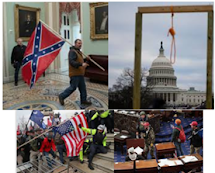
On January 6, hundreds of mostly white people stormed the U.S. Capitol. They hoisted the Confederate flag, constructed a hangman’s noose, and overcame Capitol police with guns, knives, bear spray, clubs, and
poles. They took over both congressional chambers and chanted things like “Hang Mike Pence” and “Kill Nancy Pelosi.” Their invasion ultimately caused five deaths.

For more than four hours, the mob disrupted

congressional certification of Electoral College votes. Securing the Capitol took that amount of time. In all American history, the United States Capitol building had never been taken over by domestic invaders and only once –during the War of 1812 – by foreigners.


Though many in the crowd wore Trump

clothing and carried Trump signs, some in the right wing media claimed the insurgents were actually Black Lives Matter and Antifa members masquerading as Trump supporters. Some suspect
Republican members of Congress may have helped organize the invasion or at least enabled it.


Who’s Complicit?

House Homeland Security Chairman Bennie Thompson of Mississippi and the ranking

Republican on that committee, New York’s John Katko, drafted bipartisan legislation that would have created an independent commission to investigate the January 6 insurrection. House GOP leader Kevin McCarthy regularly consulted Katko during that process and Thompson gave Katko all he asked for in the negotiations. Still, McCarthy withdrew his support and urged that Republicans vote against the measure. Only 35 GOP members ended up voting with Democrats when the measure passed the House.

In the Senate, Republicans launched a filibuster, meaning the legislation needed 60 votes. Just seven Republicans joined 50 Democrats in voting yes, so the measure failed.


Why would 43 of the 50 Republican senators not

want answers to the questions surrounding the insurrection? Who organized it, for example? Why were the invaders determined to overthrow the democratic process by violent means? What were Republican senators afraid of? Why would they not support bipartisan legislation aimed at getting the facts about such an unprecedented domestic attack on the American Capitol?  Something is clearly afloat.

One obvious answer lies in the control Donald Trump still exerts over the base of the Republican


Party. In controlling that base, he controls members of Congress it elects. “He has a grip over politicians because he has a grip over voters,” says Carol Leonnig, author of Zero Fail: The Rise and
Fall of the Secret Service. These elected officials want to maintain their offices  and the benefits that go with serving the interests of movement conservatism. An interlocking set of institutions and alliances wins elections by stoking cultural and racial anxiety while using its power in pushing an elitist economic agenda, as  Paul Krugman writes in Arguing with Zombies. Since Republicans want to regain control of the House and Senate, they know they can’t do so without the white lemming that makes up the Republican base.

In the wake of the GOP’s rejection of the January 6

commission measure, former Trump national security adviser Michal Flynn, once a three-star general in the U.S. Army, told a QAnon conference a military coup “should happen” in the United States. Flynn referred to events in Myanmar, where the military overthrew a democratically elected government on the basis of unproven allegations of voter fraud. Other similarly disturbing statements from Trump supporters haven’t gotten the attention Flynn got, but it appears treasonous comments are becoming common place among Republicans and Trump supporters.


So What’s the Bargain?

Lyndon Johnson, the nation’s 36th president, once said, “If you can convince the lowest white man he’s better than the best colored man, he won’t notice you’re picking his pocket. Hell, give him somebody to look down on and he’ll empty his pockets for you.”

Donald Trump ran for president in 2016 as the

champion of the little guy. His only significant legislative achievement, however, was a tax cut for the rich that ripped a hole in the social safety net his blue-collar supporters need. So, what do those supporters get out of the deal? Mostly, it seems, what President Johnson told us – a chance to look down on someone.      

Trump no longer pretends he’s going to make life better for working class whites in his base. They get xenophobic diatribes and racist venom directed at blacks, browns, and Asians but not much else. In the final analysis, Trump gives them someone they can look down on. Meantime, with the support of that base, the Republican Party has become the anti-democracy party. It seeks to deprive all but white people of the benefits of democracy. That’s the Faustian bargain. So they can look down on blacks, browns, Asians, and other out groups, Trump supporters discard democracy, with the complicity of their leaders.

So, we ask again – what do Biden and Hagel know? If we ignore the clear and present danger this “deal,” this “bargain” Trump’s supporters and GOP leaders have struck, we could all lose.  


Tuesday, May 21, 2019

THE ELECTORAL COLLEGE: FAIR? UNFAIR?


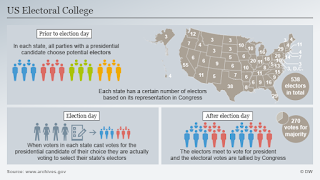
One consequence of the 2016 Presidential election has been calls for abolishing the Electoral College. Hillary Clinton received 2.8 million more votes than Donald Trump, but lost the Electoral College, 304-227.  About 107,000 votes in Pennsylvania, Wisconsin, and Michigan gave Trump his victory.
               
                                 Trump vs Clinton 2016 Presidential Election
Massachusetts Senator and 2020 Democratic hopeful Elizabeth Warren now leads the charge for dropping
the Electoral College. She, and others, see it as an undemocratic anachronism that violates the principle of one-person-one vote and unfairly blocks popular will. Conservatives (some support it only because it helped the Republican nominee last time) argue eliminating it will diminish the importance of small states and rural areas while unfairly advantaging big cities.

A Little History
The Electoral College resulted from compromises in drafting the constitution. The framers preferred letting electors choose the President, fearing demagogues would unduly influence uninformed, uneducated voters. They sought a balance between popular will and the risk of a tyranny of the majority. States with large populations might have outsized sway if the popular vote elected the President. The drafters discarded the alternative of letting Congress pick the President in favor of the Electoral College.  


The popular vote winner usually has also won the Electoral College. The 2016 result represented only the fifth time a candidate who didn’t win the popular vote captured the White House. It happened, of course, most recently before 2016 in 2000 when Al Gore won the popular vote, but lost the Presidency to George W. Bush in the Florida debacle.
 
Bush vs Gore 2000 Presidential Campaign - The fight over Florida
The Debate
Fear of harming small states now stands as the principal argument for keeping the Electoral College. Supporters say candidates would focus nearly all their attention on big cities like New York, Chicago,
Los Angeles, and Houston, not thinly populated rural states in the South and Rocky Mountain West. Wyoming, with a population of 577,000, has become the poster child for keeping the Electoral College. No Presidential candidate would pay it any attention, the story goes, if the country abolishes the Electoral College.

Fear of third parties also now gets raised as a reason
for keeping the Electoral College. Former Reagan administration official Peter Wallison contends America runs the risk of spawning a multitude of minor parties with strong, single issue focus, any one of which could elect a President in a three, four, or five party race in which the winner would only need a plurality of the popular vote. In his nightmare scenario, we’d require a run-off system or we’d face the prospect of coalition governments now seen in parliamentary systems

Those advocating change focus on the unfairness of the Electoral College. In a democracy, getting the most votes should translate into winning office. The popular will should prevail and protecting small state or rural state interests, while important, shouldn’t become the tail wagging the dog. In a system predicated on majority rule, this principle carries a great deal of weight.

A better view
Persuasive as the pure democracy rationale is, a better argument for abolishing the Electoral College may lie in the fact it doesn’t do what its supporters say it does. It doesn’t protect small state and rural state interests because candidates ignore those states in Presidential elections anyway. Voters in small states and rural areas might get more attention in a popular vote system than they do now. Presently, having a divided electorate, as measured by partisan affiliation, determines where candidates put their emphasis, not size or rural/urban status.

In 2016, two-thirds of all general election campaign
events occurred in six states – Pennsylvania, North Carolina, Florida, Virginia, Ohio, and Michigan. The nine smallest states received zero attention as measured by candidate appearances. Big states didn’t fare better. California, New York, and Texas hosted three campaign events between them. Why?  Only the “swing states” mattered. It wasn’t rural/urban status or size that determined where the candidates campaigned. They appeared where people hadn’t made up their minds. Neither Clinton nor Trump needed time in California (a cinch for Clinton) or Idaho (locked up for Trump).

Now, rural voters in New York and California (both states have plenty) get ignored, as do urban voters in Memphis and Atlanta. If every vote mattered, Republicans might see the value of appealing to blacks and browns in Seattle, Chicago, and New York. Democrats might find risky blowing off white farmers and small town dwellers in Tennessee, South Carolina, and Nebraska.

The Electoral College is part of our history.  As one advocate for keeping it wrote, “a deal is a deal.” But, the reasons for changing it now outpace the value in keeping it.

Eliminating the electoral college probably means a constitutional amendment -- a two-thirds vote in both houses of Congress and ratification by 38 states or calling a constitutional convention, which requires 34 states and has never happened. Twelve states, all controlled by Democrats except one swing state, have signed the National Popular Vote Interstate Compact in which they pledge they will vote electors for the national popular vote winner if states controlling 270 or more electoral votes agree they’ll do the same. All routes to constitutional change seem unlikely now, given the political dynamics.  
 
Who currently benefits shouldn’t determine this issue. As journalist Ryan Cooper put it, “if a Democrat ever wins the presidency while losing the popular vote, it’s a safe bet the Electoral College will be gone in about five minutes.” That’s not how a democracy should operate. Principle should dictate this decision. Increasingly, it appears principle dictates ditching the Electoral College.