Showing posts with label resign. Show all posts

Wednesday, October 13, 2021

TRUMP AS FORMER PRESIDENT: A DISCORDANT OUTLIER

Over the 245 years of the American republic, the people of the United States have come to expect certain behavior from former presidents. As with every other aspect of his association with the presidency, Donald Trump now flaunts those expectations. His conduct looks especially egregious when compared with his real peers, other one-term presidents. No matter how long his predecessors served, however, Trump looks like an aberration. 

During our lifetimes, the United States has had three one-term presidents, chief executives who got elected, served one four-year term, stood for re-election, and lost. This definition, therefore, does

not include John Kennedy, Lyndon Johnson, and Gerald Ford. Kennedy won one-term and was assassinated. Johnson finished Kennedy’s term, won one of his own, but didn’t seek re-election. Ford succeeded Richard Nixon after his resignation, but lost the 1976 election


The presidents who fit our definition come from both parties – Democrat Jimmy Carter (1977-81) and Republicans George H. W. Bush (1989-93) and Trump (2017-21). The similarity in conduct between Carter and Bush, as one-term former presidents, when juxtaposed with that of Trump, provides more evidence of 45’s decadence.

The Former President Model

Our constitution says nothing about the “role” of a

former president. We established the  conventions and traditions by example. The nation’s first president, George Washington, served two terms and didn’t run again mainly because he worried about doing anything that resembled a monarchy.


The colonists fought a bitter war for independence from a tyrannical king. Washington wanted nothing that suggested the new country was installing something similar. 

The two-term maximum continued as an informal limit on presidential tenure until Franklin Roosevelt won four terms, prompting the 22nd amendment that made the two-term limit law.  The country has

had 13 two-term presidents, along with some who got reelected but couldn’t finish their terms for reasons like assassination or scandal (Abraham Lincoln, Nixon). We’ve had eight one-term presidents under our definition.  There’s also the strange case of Grover Cleveland who was elected in 1884, lost in 1888, then regained the office in 1892 and served out that four-year term.

By and large former presidents, whether they served one term or two, have assumed a senior statesman role. Generally, they’ve left themselves out of the country’s day-to-day political machinations.


James Earl Carter, Jr. and George H.W. Bush

Jimmy Carter and the first Bush weren’t much alike as presidents. In truth, they weren’t all that alike as former presidents except in ways that speak volumes about how they conceive of the

presidency. Carter devoted himself to good  works – helping Habitat for Humanity, promoting election reform in the third world, fighting poverty, etc.  The first President Bush spent more time doing things people do when they’re retired, though he took on humanitarian relief projects at the behest of his son, President George W. Bush. These included joining in 2005 with the man who defeated him, Bill Clinton, in raising money for tsunami victims.   

If Carter and Bush did some things differently in their post-presidential lives, they also did some important things alike. Neither injected himself into politics much beyond benign activities like speaking at his party’s convention and receiving the party’s nominee during the fall campaign. Both honored the office they held by quietly counseling their successors when asked and behaving as if their election hadn’t anointed them with a divine right to influence and manage the political process though they no longer occupied the oval office.
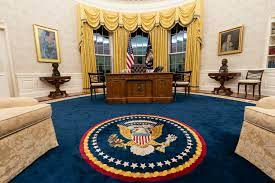


Trump’s Mischief

Since landing at Mara Largo on January 20 this year, Trump has remained a loud political  presence. Though social  media companies banned

him for distorted, untrue statements on their platforms, at rallies, through press releases, and in interviews on friendly outlets like Fox News, Trump infects our politics on a daily basis. He retains the loyalty of millions. He keeps raising money for future campaigns and, no doubt, his own use, including his mounting legal bills. He blesses favored candidates and meddles in Republican politics nationwide.

In some states, winning a Republican primary requires Trump’s endorsement. Even established GOP leaders will bow to his wishes because they so fear being out of favor with his voters. Recently, he pressured Texas Governor Greg Abbott, a Trump sycophant now faced with dropping poll numbers in his state, into ordering an “audit” of Democratic-leaning counties, even though Trump carried Texas in 2020 by 630,000 votes. No one could imagine Carter or H.W. Bush doing such a thing.

Trump, of course, keeps hinting he’ll run again in 2024. Some people who know him think he can’t resist, while others believe he won’t because he can’t stand the prospect of another defeat. He did, however, recently hold a rally in Iowa, a key early state on the 2024 primary calendar.

We know Barack Obama and Bill Clinton, both two-term presidents who can’t run again

themselves, have campaigned for Democratic nominees who wanted to follow them into the oval office. Obama, particularly, helps Democrats raise money,
partly through direct mail solicitation of small donors.  But neither has muddied the water like Trump (nor has Trump’s fellow Republican, two-termer  George W. Bush). Neither has thumbed his nose at the expectation former presidents will maintain a sense of decorum and behave as protectors of the instruments and traditions of democracy.

The American presidency was never intended as a repository for unfettered political ambition or as a mere vessel for accumulating power its holder could dispense in service of those ambitions. By tradition and experience, the nation established norms for former holders of the job that honor the limits we put on the office itself. Trump has disregarded those, just as he flaunted so many norms while he was president.  The country should call out his behavior.  We just did our part.     


Saturday, August 14, 2021

ANDREW CUOMO’S EXIT: A TALE OF TWO PARTIES – ONE REPUBLICAN, ONE DEMOCRAT - YOU CHOOSE

Two things happened Tuesday, August 10, in which Democrats – and the nation – could take

pride. First, the U.S. Senate passed President Biden’s $1.2 trillion bipartisan infrastructure bill. Second, New York Governor Andrew Cuomo announced his resignation in the wake of a sexual harassment scandal. The infrastructure deal isn’t done. The bill that passed the Senate may not clear the House unless Biden and his allies can pass a companion $3.5 trillion “human infrastructure” bill through budget reconciliation. That means we’ll have opportunities for talking about infrastructure for months.

We want to talk about the Cuomo development now! It showed the fundamental difference in our

two major political parties. Cuomo’s situation provided an apples-to-apples comparison of how Democrats and Republicans handle sexual harassment. Both have faced exams on sexual
harassment charges against one (or more) of their stars. With Cuomo’s announced departure, Democrats, in our view, passed their test. Republicans flunked the same exam numerous times.


The fact of this starkly different result makes even clearer just how much our political system has changed, and not for the better. The parties look like they evolved in separate societies; that they didn’t come from a common tradition in which decency, civility, accountability, and dedication to the rule of law triumph over the imperative of retaining power.

The Cuomo Challenge

Andrew Cuomo hails from a powerful political
family. He’s accomplished a great deal in politics on his own. His father, Mario Cuomo, served three terms as New York governor, perpetually flirting with running for president and delivering eloquent convention speeches in 1984 and 1992 that stirred Democratic hearts nationwide. Andrew Cuomo served as Secretary of Housing and Urban Development in the Clinton administration, New York attorney general, and nearly three terms as New York’s governor. He’s been an immensely effective political operative, to the point of leaving office with an $18 million campaign war chest. He’s, also, been known as someone you don’t cross in New York politics.

Despite the fear Andrew Cuomo once struck, there he was on August 10 announcing he’d  step aside,

effective 14 days later. He left to a chorus of “Amens” from local, state, and national Democrats. Unfinished business remained: (1) post-resignation impeachment proceedings that could permanently bar him from office; (2) criminal investigations; and (3) civil suits brought by his alleged harassment victims. Legislative leaders appeared genuinely divided over the first question. They must consider Cuomo’s potential complicity in a nursing home scandal and ethical
transgressions involving a book deal. They found themselves torn between moving on and a desire for accountability. Some former prosecutors thought the criminal cases might go away. The civil suits, however, will go forward and probably get settled when Cuomo pulls out his checkbook.   


Democratic Unity

Democrats forced Cuomo from office. First, fellow Democrat, Attorney General Letitia James,

conducted the investigation and authored the damning report that forced his hand. Second, New York’s political leadership quickly called for Cuomo’s resignation. They’re all Democrats – U.S. Senators Chuck Schumer and Kirsten Gillibrand,  New YorkCity Mayor Bill de Blasio, and strong majorities in the state legislature. After the James report, they all said Cuomo should leave.  Third, President Biden weighed in early, asserting that if the James investigationproved the allegations against Cuomo, he should resign. Biden restated that position once the report came out. It showed credible evidence supporting the allegations of 11 women who charged Cuomo with offensive touching, creation of a hostile work environment in his office, and other transgressions. 

The Democratic unity left Cuomo no running room. Nobody defended him. As legislative impeachment machinery moved into high gear, Cuomo ran out of options. Timing represented the major surprise in the August 10 resignation announcement.  Many expected he’d leave eventually, but most observers thought the combative Cuomo would fight long and hard in an effort to hang on as long as he could.


And Republicans?

As suggested, we believe the most important aspect of the Cuomo resignation story resides in the difference between how Democrats reacted to his difficulties versus how Republicans handled similar situations. First, of course, there’s former President Donald Trump. Must we reiterate the facts of the Access Hollywood tape and the Stormy Daniels payoff? Those Trump sins (and others) were arguably worse than Cuomo’s, but Republicans stood by him.  Had Republican leaders abandoned Trump in October 2016 after the Access Hollywood tape emerged, the nation likely would have been spared the disaster that was the Trump presidency.

Then, there are the Republican second stringers like

Florida Congressman Matt Gaetz, accused of sex trafficking in underage girls, and Ohio Congressman Jim Jordan, who allegedly helped cover up sexual abuse allegations in the Ohio State University wrestling program while he coached there. In each instance, Republican members of Congress and other GOP elected officials stood by these bad actors or remained silent, which is as bad (or worse).

We’ve said we think America needs two viable political parties arguing over ideas and policy.  We’ve also said we don’t need this Republican Party because it’s not interested in character ideas or policy, only in keeping power. The Cuomo affair demonstrated that we have one party that will police itself in the name of fidelity to our values and institutions.  The other party, as currently led and configured, won’t do that. It deserves that special place in hell for those who thrash those cherished values and institutions.