Showing posts with label black. Show all posts

Saturday, August 22, 2020

THE VIRTUAL 2020 DEMOCRATIC NATIONAL CONVENTION: A RULE OF THREES


it to building an airplane in flight. With the convention hall empty, no delegates in funny hats, and balloon drops unavailable, the party grabbed the nation’s attention with four nights of videos, speeches without live audiences, and innovations on time-honored traditions, like a roll call that nominated former Vice President Joe Biden from 57 locations. We don’t know yet if Biden got the “bounce” in the polls convention planners covet, but they set the bar high for Republicans who take their turn starting August 24.

The three of us sat on the sidelines and watched intently. We saw some other threes worth noting.

Three Messages
First, Democrats offered a big tent. In executing their presentation, the party defined its mission as making democracy available to all, from the most privileged to the most marginalized, and everyone in between. Establishment figures, including Republicans, played their part, as did union members, front-line health workers, and ordinary people with compelling stories of personal tragedy. The objective, admittedly not easily accomplished, was moving the nation forward as one.
Second, we’ve known for a while whoever won the 2020 Democratic nomination would have restoring America’s place in the world as one of his or her most important jobs. Tuesday night, two former Secretaries of State vouched for Biden on that front.
Democrat John Kerry and Republican Colin Powell assured the nation Biden will stand up to America’s adversaries and stand with its allies. Cindy McCain narrated a film celebrating Biden’s long friendship with her late husband, John McCain, a Vietnam war hero and national security icon.

Third, through technology and the speeches, Democrats made clear the threat posed by another four years of President Donald Trump. No matter how much inclusion or how many progressive ideas the party promotes, none of it matters unless Americans vote and remove the clear and present danger continuation of the Trump presidency represents.

The Wednesday night contrast of Kamala Harris’s vice presidential acceptance speech and former President Barack Obama’s grave warning about Trump drove home that point. Her history-making moment as the first woman of color on a national ticket won’t mean much unless voters exorcise the Trump cancer.

Three Speeches
Political conventions are about nothing if not speeches. We saw plenty of them from our sideline perch - some really good, some ordinary, some mediocre. We saw three that potentially merited the label GREAT:

Michelle Obama showed Monday night why she is so impactful. Admitting she “hates politics,” the former First Lady of the United States delivered a masterful expose’ on what Americans must do in the face of Trump’s voter suppression campaign. Voting in this election may mean standing in line “all night if you have to,” so pack a lunch and breakfast too, she urged.

Barack Obama on Wednesday night framed the electoral choice in the starkest, gravest terms imaginable. No former president had ever expressed publicly such a dire view of a successor. But, in our view, the speech met the moment. We can’t say we haven’t been warned.
                                                                 

Joe Biden gave an acceptance speech for the ages. He promised he’d run as a “proud Democrat” but govern as an “American president.” Robbed of the cheering crowd, he seriously and soberly laid out his plans for the country and drew the starkest contrast possible with Trump. Any suggestion he’s not up to the task mentally melted away in a flurry of direct, succinct sentences, well-organized thoughts, and powerfully delivered phrases. 

Three Ordinary People; Three Special Moments
The virtual format made it easier showcasing ordinary people intersecting with national politics. Consider Kristin Urquiza, Jacquelyn Brittany, and Brayden Harrington. They’re famous now because of this convention.
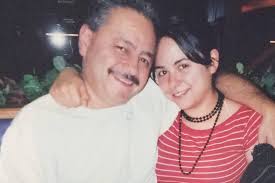
Kristin and her father. Click on image to watch video.
*Kristin Urquiza of Arizona Monday night told of her father’s death from COVID -19. She boldly declared the 65-year old man’s “only pre-existing condition was  trusting Donald Trump.” He took the word of Trump and Arizona’s Republican governor that going to a bar in June was safe. He contracted the virus and died. His daughter now crusades against the president’s reckless, inept handling of the pandemic.

*Jacquelyn Asbie operates the elevator in
the building where The New York  Times editorial board meets with candidates. When Biden arrived in January for his interview, the candidate befriended her. He asked that she place his name in nomination for President of the United States, relegating high-powered members of Congress to seconding speeches. 

*Brayden Harrington is a teenager from Concord, New Hampshire. He stutters. Biden did too as a child. When they met, Biden
schooled him on things that helped him overcome his speech impediment. Before a national television audience, Brayden helped introduce Biden’s acceptance speech and went viral in the process.

Many of the talking heads on cable networks asked if political conventions will ever revert to what they were, even after the pandemic. It’s a fair question only time can answer. Whatever the answer, the 2020 Democratic convention will always stand as a first – a monument to innovation, an airplane built in mid-air, a seminal moment in the sea of
political history. Which metaphor proves best partly depends on what happens between now and November 3.  Regardless, it was quite a show, even if we did have to watch from the sidelines.  


Monday, June 15, 2020

GEORGE FLOYD, DREW BREES, TEACHING, AND READING ASSIGNMENTS: THE EDUCATION OF WHITE AMERICA ABOUT RACE


George Floyd’s family buried him June 9 after
services in Minneapolis, North Carolina, and Houston. The trauma his murder caused his family, African Americans generally, and many whites continues. Since we can’t discuss all the things that surfaced from the Floyd case, we’ve picked one we think urgent and interesting: talk between African Americans and whites about race.
The three of us see value in African Americans engaging whites on race. Some African Americans think that’s a waste of time, offering some version of, “Educating white people about race isn’t our responsibility. They should figure it out for themselves.” Those arguing that note it’s been tried for years with disappointing results. We understand the underlying frustration, but we hold a different view.

Drew Brees: Tone Deaf
We can’t find a better example of why we think engaging white Americans on race makes sense than the case of New Orleans Saints quarterback Drew Brees. After Floyd’s death, Brees clung to the familiar talking point that he could “never agree with anyone disrespecting” the flag when asked about his feelings now on former San Francisco 49ers quarterback Colin Kaepernick and kneeling during the national anthem. Because Brees counts as a “good guy,” his comments showing he didn’t get it felt worse than had they come from a source known for insensitivity. His community service record in predominately black New Orleans suggested he understood better than many white NFL players the need for recognizing the impact of racism on African Americans. He led Katrina recovery efforts, donated millions for feeding the hungry during the pandemic, and helped rebuild parks and playgrounds.

Black NFL players, including his Saints teammates, pushed back. They said Kaepernick’s protest had nothing to do with the flag or the military, which Brees referenced in mentioning the Second World War service of his grandfathers. San Francisco defensive back Richard Sherman tweeted, “He’s beyond lost. Guarantee you there were black men fighting alongside your grandfather, but this doesn’t seem to be about that. That uncomfortable conversation you are trying to avoid by injecting military into conversation about brutality and equality is part of the problem.”
Brees apologized, saying he was “sick about the way my comments were perceived,” and
that his “insensitive” statements “completely missed the mark on the issues we are facing now as a country.” San Francisco Chronicle columnist Ann Killion wrote that his apology “felt late…Four years late.”

It Is About Race
The Brees story illustrates how even well-intentioned white people convert discussions
of racial animus into discussions about something else. “This isn’t about race” we’ve heard  often. As sociologist Robin DiAngelo writes in  White Fragility: Why It’s So Hard for White People to Talk About Racism, “Most white people have limited information about what racism is and how it works. For many white people, an isolated course taken in college or required … in their workplace is the only time they may
encounter a direct and sustained challenge to their racial reality.” That reality includes the fact that, according to a Public Religion Research Institute study, 75 % of white Americans have entirely white social networks. If Drew Brees, who plays in a league that’s about 70% black, has trouble understanding why kneeling concerned brutality and inequality, not the flag and the military, what about those in the 75%?          
We believe the Floyd case and the angst it produced are about race. The protests are
about the disparity in police treatment of African Americans and whites. The Floyd case and the protests are about the fact every African American faces a greater risk of being the victim of police assault than does a white person, regardless of education, socioeconomic standing, or zip code. It is about race.

Class Assignments
White people often ask what they should do to better understand racism. We believe
African Americans should keep talking with whites about the challenges of living in America as descendants of enslaved people. We would not leave our white brothers and sisters to their own
devices and conversations among themselves about the nature of that experience. We recall from the Bible (the word of God for some, wisdom literature for others, and meaningless fable for others) Matthew 15:14, which says “… and if the blind
lead the blind, both shall fall into the ditch.” As distressing as some may find it, we must say that when it comes to racism, many white Americans are blind.

Still, the responsibility for whites learning about the effects of racism doesn’t fall solely on African Americans. Recently  on his church’s call-in forum, Woodson noted the importance of studying the history of this problem. That’s part of anti-racism work. With this topic, ignorance is not  bliss. Woodson suggested our three favorite books on race – Isabel Wilkerson’s The Warmth of Other
Suns, The Color of Law by Richard Rothstein, and Edward Baptist’s The Half Has Never Been Told. Henry adds Ralph Ellison’s great novel, Invisible Man. We understand the tough sledding these books sometimes require, so we also offer works that present the issue in more digestible form:
·Racing Across the Lines: Changing Race Relations Through Friendship by Deborah Plummer;
·Me and White Supremacy: Combat Racism, Change the World, and Become a Good Ancestor by Layla F. Saad;
·So You Want to Talk About Race by Ijeoma Oluo; and
·How to be an Antiracist by Ibram X. Kendi.
At least one of us has read all these titles and believes each teaches something about how African Americans and whites can talk concerning race and about white intra-race talk, something we see as valuable. None pull
punches. Some readers may find parts of them disturbing. We think that’s necessary, seeing virtue in the old saw about comforting the afflicted and afflicting the comfortable. What we've been doing certainly hasn’t worked.